Skip to content
Sliced veneer

We do not buy flitches. We slice our own logs.

Face veneer in American white oak, red oak and black walnut — cut at our own operation in Türkiye from logs we bought and graded in the United States. The leaf and the log come from the same company, which is the whole point.

Veneer in brief

What Silvestryn's sliced veneer is

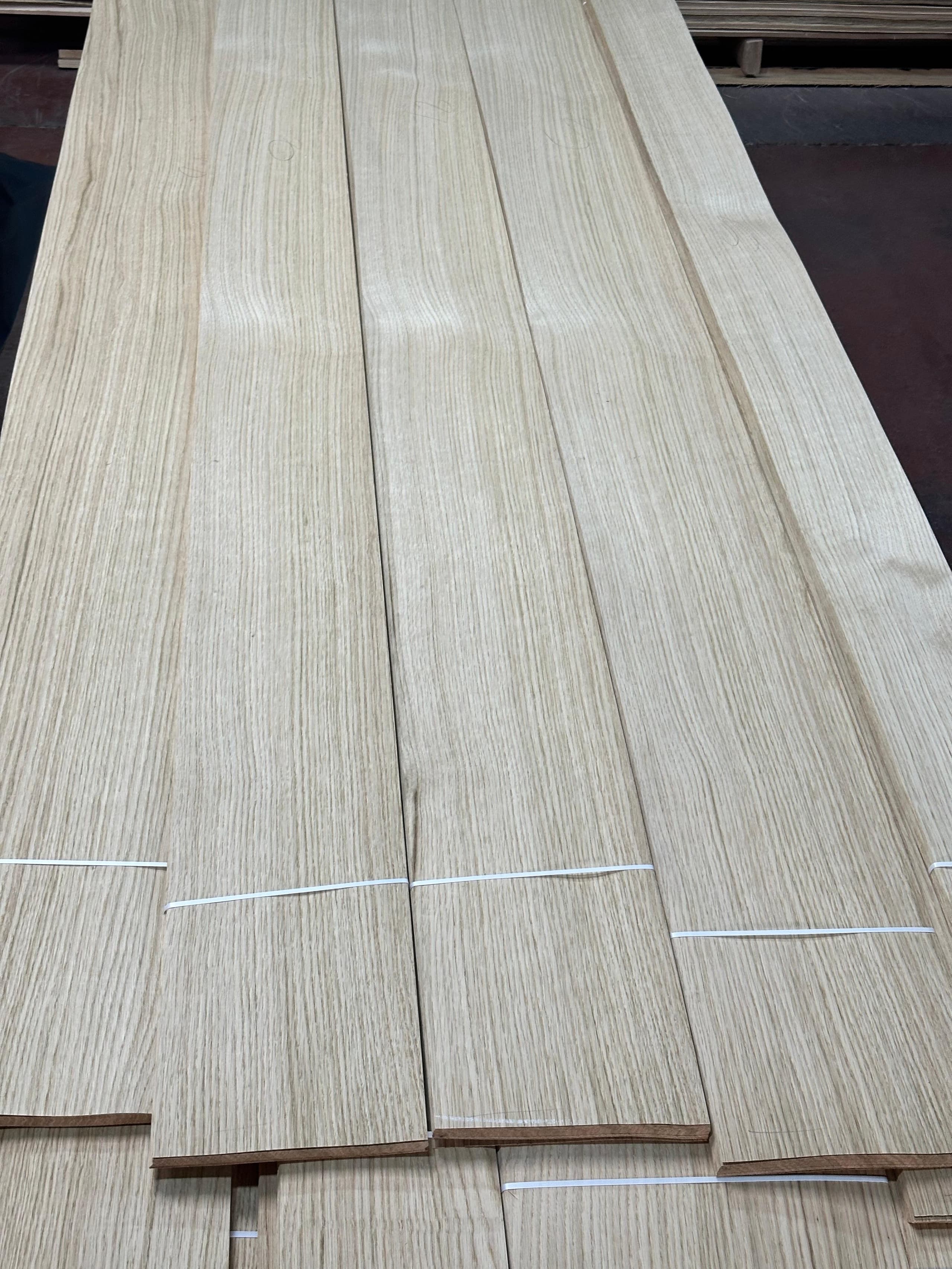
Sliced veneer is a thin leaf of hardwood cut from a log with a knife rather than sawn, so almost nothing is lost to sawdust and one high-grade log can face a very large area of finished work. Silvestryn slices American white oak (Quercus alba), northern red oak (Quercus rubra) and American black walnut (Juglans nigra) in quarter, crown and rift cuts, supplied as sequence-matched bundles kept in flitch order.

The logs are bought and graded in West Virginia and Ohio, shipped to our slicing operation in Türkiye, cut to face-veneer specification and exported worldwide from Turkish ports. Nothing is traded on in between. That means the grading decision at the landing, the choice of how the flitch is opened, and the sequence that reaches your bench are all made by the same company — rather than inherited from whoever sold the flitch on.


Why it matters

Owning the log changes what the leaf can be.

Most veneer sellers buy flitches. That is a legitimate business, but it means every decision that determines the face has already been made by someone else, for their reasons.

  • 01

    We buy the log

    The flitch starts as a log we graded ourselves in West Virginia or Ohio, against our own defect criteria. A veneer mill buying flitches on the open market inherits whatever decision someone else made at the landing.

  • 02

    We ship it to our own line

    Logs move from US ports to our slicing operation in Türkiye. Nothing is traded on in between, so the log that was tallied in the yard is the log that reaches the knife.

  • 03

    We decide how it is opened

    Knowing what is inside a log decides whether it is quartered, crowned or rifted, and where the flitch is opened. That judgement is worth more to the finished face than any tolerance written into a contract.

  • 04

    Sequence survives to your bench

    Leaves are kept in flitch order from the knife to the pallet. A matched face across a panel run depends on a sequence never being broken, and every hand a bundle passes through is a chance to break it.

Cuts

Three ways to open a log, three completely different faces.

The cut is chosen before the flitch is mounted and cannot be revised afterwards. It is the single decision that does most to determine what the finished panel looks like.

01

Quarter cut

The log is quartered and sliced perpendicular to the growth rings, giving a straight, tight, uniform stripe. On white oak it is the only cut that opens the medullary rays into ray fleck — the figure European specifiers ask for by name.

02

Crown cut (flat)

Sliced parallel to a line through the centre of the log, producing the cathedral or flame figure at the leaf centre that runs out to a stripe at the edges. The highest yield per log and the most familiar face in furniture and joinery.

03

Rift cut

Sliced at a slight angle off the quarter, specifically to suppress ray fleck and leave a very linear, even grain. Specified on oak where the design calls for a quiet face rather than a figured one.

Sliced white oak veneer leaves banded in sequence, showing straight even grain
Specification

Sliced Hardwood Veneer

Face veneer sliced from our own American logs. Because we buy the log, we know what is inside it before it reaches the slicer — which decides how a flitch is opened, how the leaves are kept in sequence, and whether a buyer gets a face that matches across a whole panel run.

Export specification

Sliced hardwood veneer export specification
SpeciesAmerican white oak, red oak and black walnut
Thickness0.50, 0.55 and 0.60 mm standard
Length2,000–3,200 mm
Width120 mm and up, sorted by band
CutQuarter, crown (flat) and rift
Moisture8–12 % on despatch
GradeA, B and C faces; backing veneer to order
PresentationSequence-matched bundles, kept in flitch order
PackingPalletised and containerised; 40' HC

Who buys it

  • Plywood and decorative panel producers
  • Furniture and cabinet manufacturers
  • Architectural joinery and interior fit-out
  • Door and flush-panel producers
Shipping

Veneer loads from Türkiye, worldwide.

Sliced veneer ships palletised and containerised out of Turkish ports to any discharge port you name — Europe, the Middle East, Asia, the Americas. Logs continue to load from the eight US Atlantic and Gulf ports. A buyer taking both runs them as separate shipments on one commercial relationship, with the same contracts, the same documentation standard and the same point of contact.

  • Shipped worldwide from Turkish ports
  • Sequence-matched bundles, palletised
  • 40' high-cube containers
Veneer questions

What buyers ask about cuts, sequence and origin.

What is sliced veneer?

Sliced veneer is a thin leaf of hardwood cut from a log with a knife rather than sawn, so almost nothing is lost to sawdust. It is used as the visible face of plywood, decorative panels, furniture and joinery, letting one high-grade log face a very large area of finished work.

Where is Silvestryn's veneer sliced?

In Türkiye. American white oak, red oak and black walnut logs are bought and graded in the United States, shipped to our slicing operation, cut to face-veneer specification, then exported worldwide from Turkish ports.

What is the difference between quarter, crown and rift cut veneer?

Quarter cut slices perpendicular to the growth rings for a straight uniform stripe, and on white oak it is the only cut that opens the medullary rays into ray fleck. Crown (flat) cut gives the cathedral figure at the leaf centre and the highest yield per log. Rift cut is angled slightly off the quarter specifically to suppress ray fleck and leave a quiet linear grain.

Which species does Silvestryn slice?

American white oak (Quercus alba), northern red oak (Quercus rubra) and American black walnut (Juglans nigra) — the same three species we export as logs, sliced from logs we bought and graded ourselves rather than bought in as flitches.

Is veneer supplied in sequence?

Yes. Leaves are kept in flitch order and supplied as sequence-matched bundles, which is what makes a face match across a run of panels. Because we buy the log, the sequence is controlled from the flitch onward rather than reconstructed after purchase.

Can veneer and logs ship on the same contract?

Yes. Buyers who take both usually run them as separate shipments on one commercial relationship, because the logs load from the United States and the veneer loads from Türkiye. Contracts, documentation and the point of contact stay the same.

Next step

Send us the face you need and the area you have to cover.

Species, cut, thickness, the panel size you are facing and roughly how much of it — that is enough for us to tell you which of our logs it should come off, and what it costs.