Skip to content
Product range

What we grade, load and ship.

Two lines with completely different economics: appearance-grade logs sold on figure and grade, and industrial fibre sold on tonnage and cleanliness. Every specification below is the starting point for a quote, not a fixed catalogue — tell us what your mill actually needs.

Specification summary

What Silvestryn supplies, with the numbers

A veneer-grade log is a log straight, sound and clean enough to give a slicer or peeler a long, uninterrupted face. Silvestryn supplies three species to that standard: American white oak from 16" small-end diameter (40 cm +), and northern red oak and American black walnut from 14" (35 cm +). Oak ships in 8–16 foot lengths, walnut in 8–12 foot, with sweep held to a maximum of 1" per 8 feet, ends sealed and every piece individually tallied.

The second line is industrial fibre, sold on tonnage rather than appearance. MDF-grade hardwood chips target an 8–45 mm accept fraction at 90 % or better, with fines below 3 %, oversize below 3 % and bark content below 1 %. Hardwood pulpwood ships as roundwood bolts, 8 feet standard, 4" minimum top diameter and 22" maximum butt. Volume is quoted in Doyle, Scribner, International 1/4" or metric cubic metres — whichever rule the contract names.

Line 01 — Appearance grade

Veneer-grade hardwood logs

Selected for slicing and peeling: straight, sound, minimum sweep, free of metal, ends sealed against checking. Graded and tallied piece by piece before anything moves toward a port.

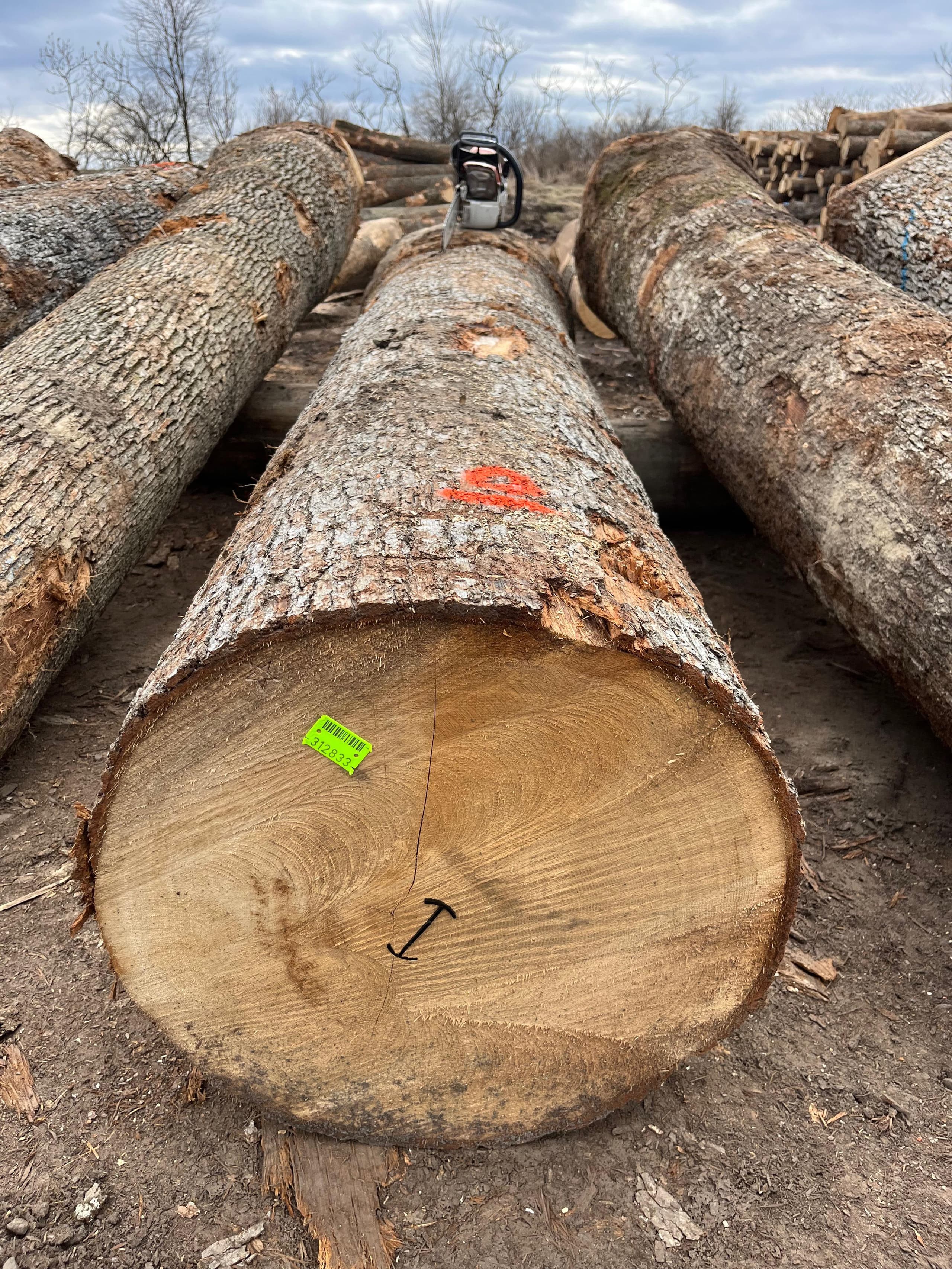
American white oak veneer log, sawn end showing tight growth rings and pale creamy heartwood, graded and marked in the yard

Appalachian and Northern hardwood belt

Quercus alba

American White Oak

The species European buyers ask for by name. Closed cellular structure and pronounced medullary rays give quartered white oak its ray fleck — and make it the only US oak accepted for tight cooperage.

Export specification

American White Oak export specification
Small-end diameter16" and up (40 cm +)
Length8'–16' (2.4–4.9 m)
GradeVeneer / Prime — AAA, AA, A
SweepMax 1" per 8' of length
MeasurementDoyle, Scribner or metric m³
PresentationEnds sealed, bark on or debarked

Typical end use

  • Sliced and rotary veneer
  • Tight cooperage — wine and whiskey
  • Architectural joinery and panel faces
  • Engineered flooring wear layers

Northern tier — Pennsylvania through the Great Lakes

Quercus rubra

Northern Red Oak

Faster-grown and more open-pored than white oak, with a warm pink cast that takes stain evenly. The volume workhorse of the American hardwood export trade.

Export specification

Northern Red Oak export specification
Small-end diameter14" and up (35 cm +)
Length8'–16' (2.4–4.9 m)
GradeVeneer / Prime and No.1 sawlog
SweepMax 1" per 8' of length
MeasurementDoyle, Scribner or metric m³
PresentationEnds sealed, bark on or debarked

Typical end use

  • Sliced veneer and plywood faces
  • Furniture and cabinet components
  • Solid and engineered flooring
  • Interior mouldings and millwork
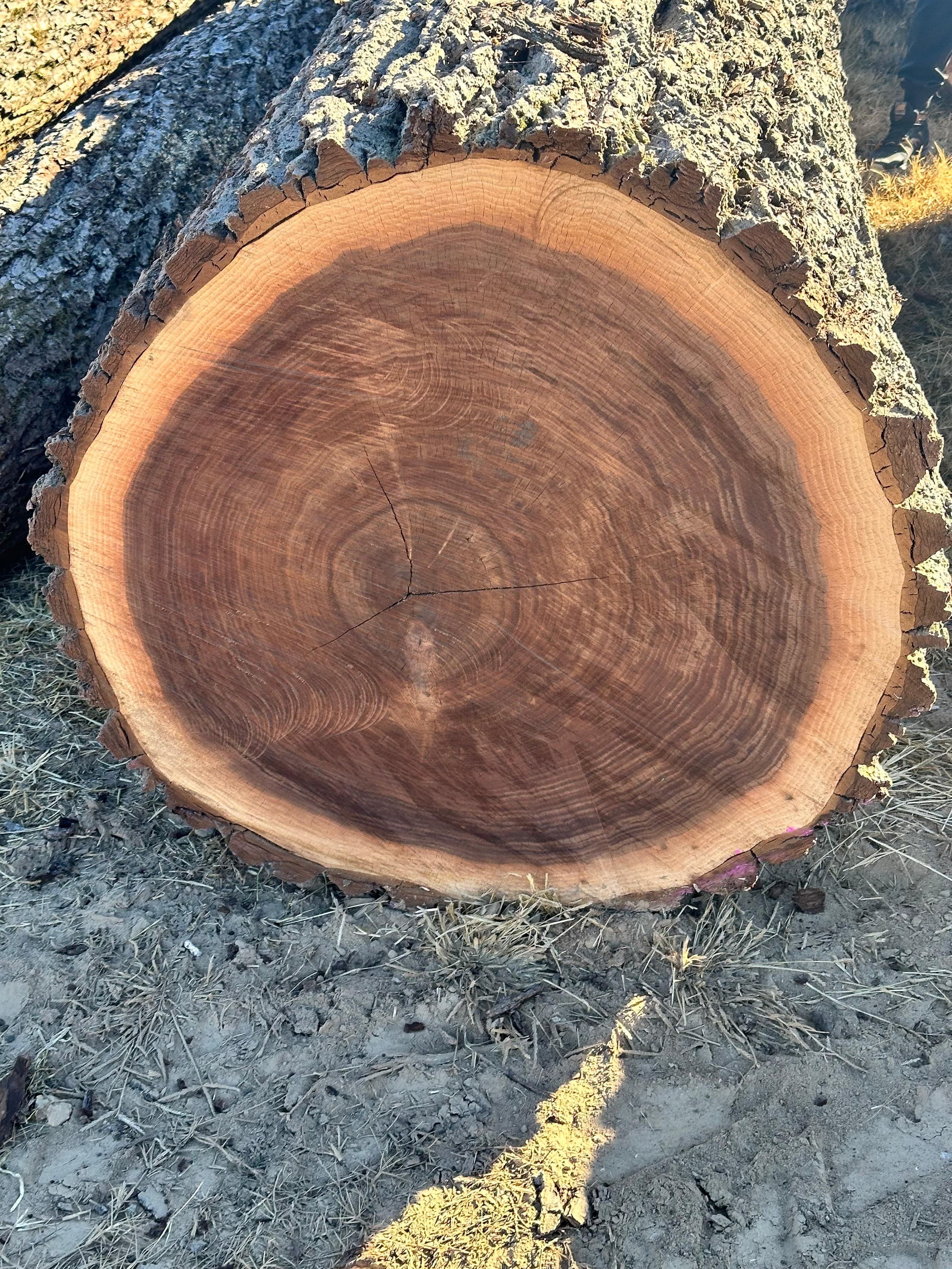
American black walnut log end showing rich chocolate-brown heartwood and concentric growth rings

Central states — Missouri, Iowa, Indiana, Ohio, Kansas

Juglans nigra

American Black Walnut

The most valuable hardwood grown in North America, and the one buyers inspect log by log. Colour, figure and butt-log character drive the price far more than volume does.

Export specification

American Black Walnut export specification
Small-end diameter14" and up (35 cm +)
Length8'–12' (2.4–3.7 m)
GradeVeneer / Prime — selected log by log
FigureCrotch, stump and curl offered when available
MeasurementPer log, or metric m³
PresentationEnds sealed, individually tallied

Typical end use

  • High-end sliced veneer
  • Gunstock and instrument blanks
  • Executive furniture and interiors
  • Architectural feature panels

A note on measurement

American log rules — Doyle, Scribner and International 1/4" — produce materially different volumes from the same log, and Doyle in particular under-measures small diameters. Most of our overseas buyers contract in cubic metres. We are happy to quote in any of them, but the rule must be named in the contract: a price per thousand board feet means nothing until you know which rule produced the thousand.

Line 02 — Industrial fibre

Pulpwood and MDF-grade wood chips

Panel and pulp mills do not buy appearance — they buy consistency. Screening discipline, bark content and moisture are what decide whether a cargo runs clean through the digester or gets discounted on arrival.

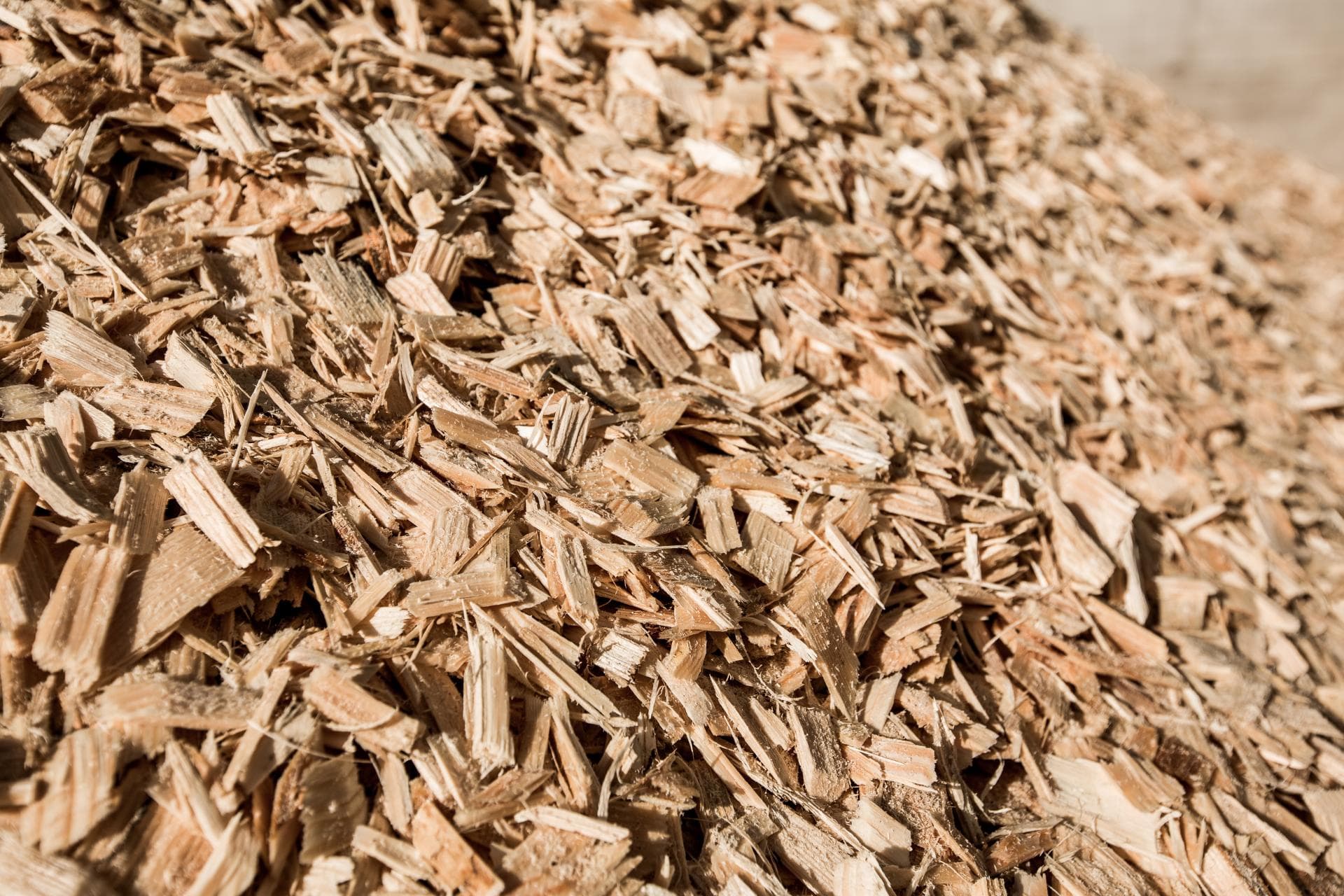
Illustration of screened hardwood chips packed within a consistent size band

MDF-Grade Hardwood Chips

Clean, screened hardwood chips produced to panel-mill intake specification. Fines and oversize are screened out before loading, and bark content is held down at source — the two variables that decide whether a cargo runs or gets rejected at the digester.

Specification

MDF-Grade Hardwood Chips specification
SpeciesMixed US hardwood; single-species on request
Accept fraction8–45 mm, target 90 % +
Fines (< 3 mm)Below 3 %
Oversize (> 45 mm)Below 3 %
Bark contentBelow 1 %
MoistureGreen 45–50 %, or dried to spec
ContaminantsFree of metal, stone, plastic and soil
ShipmentBulk vessel or containerised

Who buys it

  • MDF and HDF panel producers
  • Particleboard mills
  • Pulp and fluff pulp mills
  • Biomass and pellet producers
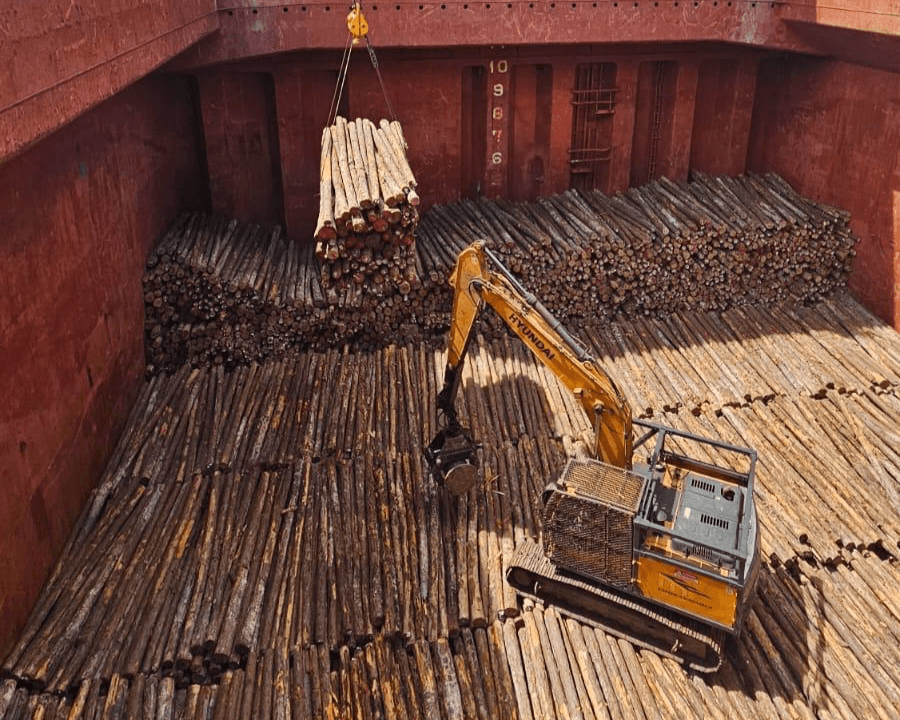
Excavator loading hardwood pulpwood roundwood for export at the yard

Hardwood Pulpwood

Roundwood below veneer and sawlog grade, sold on weight rather than appearance. The economics live in freight and consistency, so we build pulpwood programmes around a fixed loading port and a repeating monthly tonnage.

Specification

Hardwood Pulpwood specification
FormRoundwood bolts, cut to buyer length
Length8' standard (2.4 m); other lengths to order
Top diameter4" minimum (10 cm)
Butt diameter22" maximum (56 cm)
ConditionSound, straight, free of char and metal
MeasurementGreen short ton, metric tonne or cord
ShipmentBulk vessel; containers for trial lots

Who buys it

  • Kraft and mechanical pulp mills
  • MDF and particleboard producers
  • Biomass energy plants
Line 03 — Value added

These same logs are also sold as sliced veneer.

White oak, red oak and walnut logs off this page are shipped to our own slicing operation in Türkiye and cut to face-veneer specification in quarter, crown and rift. If you need the face rather than the log, the specification is on its own page.

Specification questions

What buyers ask about grade, size and measurement.

What is a veneer-grade log?

A veneer-grade log is a log straight, sound and clean enough to give a slicer or peeler a long, uninterrupted face. It must hold minimum sweep, carry no heart rot, shake or ring failure, and present clear faces free of unsound knots. That is a much narrower window than a good-looking sawlog.

What is the difference between American white oak and red oak?

White oak (Quercus alba) has a closed cellular structure and pronounced medullary rays, which give quartered stock its ray fleck and make it the only US oak accepted for tight cooperage. Red oak (Quercus rubra) is faster-grown and open-pored, with a warm pink cast that takes stain evenly.

What diameter and length do hardwood veneer logs need for export?

White oak veneer logs run 16" small-end diameter and up (40 cm +); red oak and black walnut run 14" and up (35 cm +). Standard lengths are 8–16 feet for oak and 8–12 feet for walnut, with sweep held to a maximum of 1" per 8 feet of length.

What specification do MDF-grade wood chips have to meet?

Our MDF-grade hardwood chips target a 8–45 mm accept fraction at 90 % or better, fines under 3 mm below 3 %, oversize above 45 mm below 3 %, and bark content below 1 %. Moisture ships green at 45–50 % or dried to specification, free of metal, stone, plastic and soil.

What is the difference between pulpwood and sawlogs?

Pulpwood is roundwood below veneer and sawlog grade, sold on weight rather than appearance, and bought for fibre by pulp, MDF, particleboard and biomass mills. Sawlogs are sold on grade and dimension for conversion into lumber. We never mix sawlogs into a veneer parcel to inflate volume.

How is log volume measured — board feet or cubic metres?

We quote in Doyle, Scribner, International 1/4-inch or metric cubic metres, but the rule must be named in the contract. The three American log rules produce materially different volumes from the same log, and Doyle in particular under-measures small diameters. Most overseas buyers contract in cubic metres.

Not listed?

If you need a species or a grade that is not on this page, ask.

Ash, hard maple, cherry, hickory, poplar and softwood chip programmes come up regularly. The range above reflects what we ship most, not the limit of what we can source.